Did Massachusetts Question 7 pass — and what does it mean for my lot?
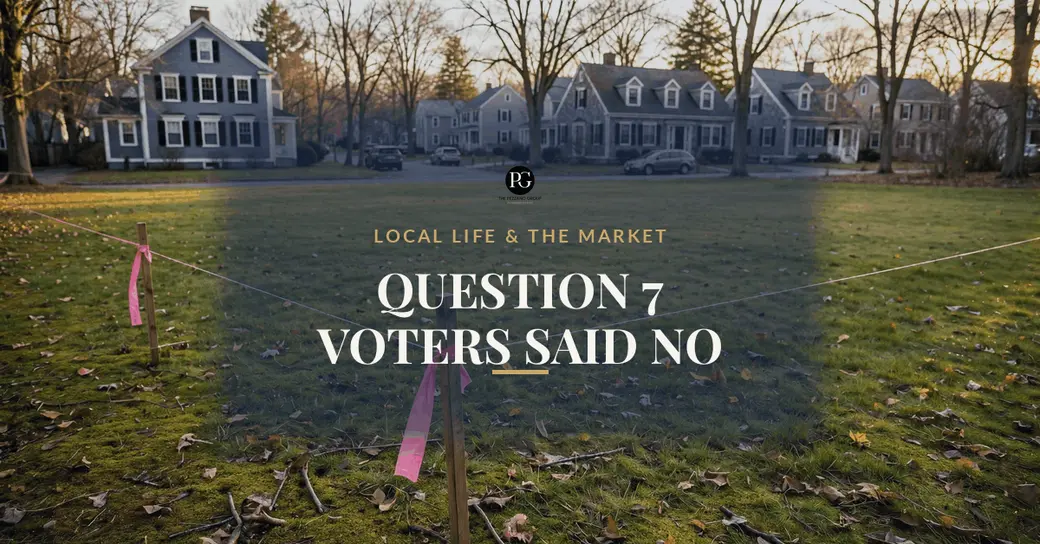
Short answer: The Associated Press has called it — Question 7 failed. With about 99% of the expected vote counted, the unofficial AP tally is No 1,288,536 to Yes 1,255,595 (about 50.6% to 49.4%), a margin of 32,941 votes. An AP call is a projection, not the official result: the outcome becomes official only when the Secretary of the Commonwealth certifies it, expected the first Wednesday in December. For your lot, the operative fact is simple — nothing changes. Your town's existing minimum lot sizes stay exactly as they were on Monday.
What Question 7 would have changed
Question 7 was the only housing question on the November 3 ballot. It proposed amending the state Zoning Act (Chapter 40A) so that a single-family home could be built on any residential lot of at least 5,000 square feet with at least 50 feet of street frontage, as long as the lot has public water and sewer — no matter how much larger a town's own minimum lot size is. Boston was exempt; it runs on its own zoning code, outside Chapter 40A.
In plain terms: in towns that require a half-acre, an acre, or more to build one house, the state would have set the floor at 5,000 square feet — roughly a tenth of an acre — wherever water and sewer already run. Supporters pitched it as a starter-homes measure: smaller lots, smaller houses, a rung on the ladder for first-time buyers and downsizers. A Tufts University Center for State Policy Analysis report estimated it would generate roughly 750 additional homes a year statewide. Opponents, including the Massachusetts Municipal Association, argued that lot size is exactly the kind of decision town meetings exist to make.
A coin flip, all night long
This was not a normal ballot question. On election night the lead flipped back and forth — at one point on Wednesday morning, with about 80% counted, Yes led by 195 votes. Out of more than 2.5 million cast. Boston voted about 69% Yes — for a law that would not have applied inside Boston. Suburbs split hard in both directions: several towns that fought over the MBTA Communities Act voted Yes, while Wellesley, Winchester, and Lexington — suburbs where new smaller-lot homes would have been most valuable — voted No decisively.
Read that split honestly and it tells you something true about our towns: Massachusetts is genuinely divided, almost exactly down the middle, on who should decide how big a building lot has to be — the state, or the town. That argument does not end with this result. It goes back to town meetings, zoning boards, and the State House — where it has always been fought.
The Massachusetts specifics: what happens next
The AP called the race for No on Friday, and the path from here is short. The result stays unofficial until the Secretary of the Commonwealth certifies it, expected the first Wednesday in December; late-arriving mail ballots and provisional ballots are still being added in the meantime, but the outcome is not in doubt. Two things worth knowing:
- No recount: state law allows a recount petition only when the margin is half a percent or less. The margin here is about 1.3 points — well outside that band, so December's certification is a formality, not a cliffhanger.
- Had it passed: a ballot law takes effect 30 days after certification, and the Legislature could have modified it first. That road is closed — there is no state floor coming, no implementation regulations, no January effective date.
What replaces it is the old process: any town can lower its own minimum lot sizes at town meeting, and the Legislature can take the question up in session. A state that split 50.6 to 49.4 has not heard the last of this idea — but it will arrive the slow way, town by town and bill by bill.
If you own a big lot, here's your angle
This is the part that matters to homeowners in towns like ours. Under the rules that just survived the vote, an oversized lot — the kind plenty of longtime owners in Malden, Wakefield, Melrose, and Reading sit on — is worth what today's zoning says it is, no more and no less. The statewide shortcut to a second buildable lot (5,000 square feet, 50 feet of frontage, public water and sewer, over any town's larger minimum) is off the table, and anyone who tells you otherwise is speculating.
That doesn't mean a big lot has no options — it means the options are the local ones that always existed. If your lot already meets your town's requirements for a subdivision, that math was true before the vote and is still true now. What died on Tuesday is only the state handing owners a by-right split over their town's objection.
The homework is still worth doing, for keeps: know your lot's size and frontage, know whether you're on public water and sewer, and know your town's current minimums and subdivision rules. If this idea returns — and a 1.3-point loss says it will — you'll know in one sitting whether it touches your land.
Frequently asked questions
Did Question 7 pass or fail?
It failed. The Associated Press called the race for No on Friday — No 1,288,536 to Yes 1,255,595 (about 50.6% to 49.4%) with roughly 99% of the expected vote counted. The result is unofficial until the Secretary of the Commonwealth certifies it, expected the first Wednesday in December.
Can there be a recount?
No. State law allows a recount petition only when the margin is half a percent or less; this margin is about 1.3 points (32,941 votes). December's certification makes the result official.
Does Question 7 apply to Boston?
No. Boston is exempt because it operates under its own zoning code rather than Chapter 40A — even though Boston voters supported the question by roughly two to one.
Own a lot that's bigger than your house needs? Find out what it's worth under today's rules — the same rules that were in place before the vote. Dan Pezzano, 617-417-9108 · Pete Pezzano, 617-913-2730 — or check your home's current value on our valuation page. No pressure, no obligation.
Published by The Pezzano Group | Powered by Rise Signature Homes · Licensed Massachusetts real estate team
Figures: Associated Press unofficial results (No 1,288,536 / Yes 1,255,595, ~99% of expected vote; race called for No by the AP on November 6) and Secretary of the Commonwealth, verified November 2026; Tufts University Center for State Policy Analysis estimate as reported by Banker & Tradesman.
This is general information about Massachusetts rules, not legal or tax advice for your situation.
Categories
Recent Posts